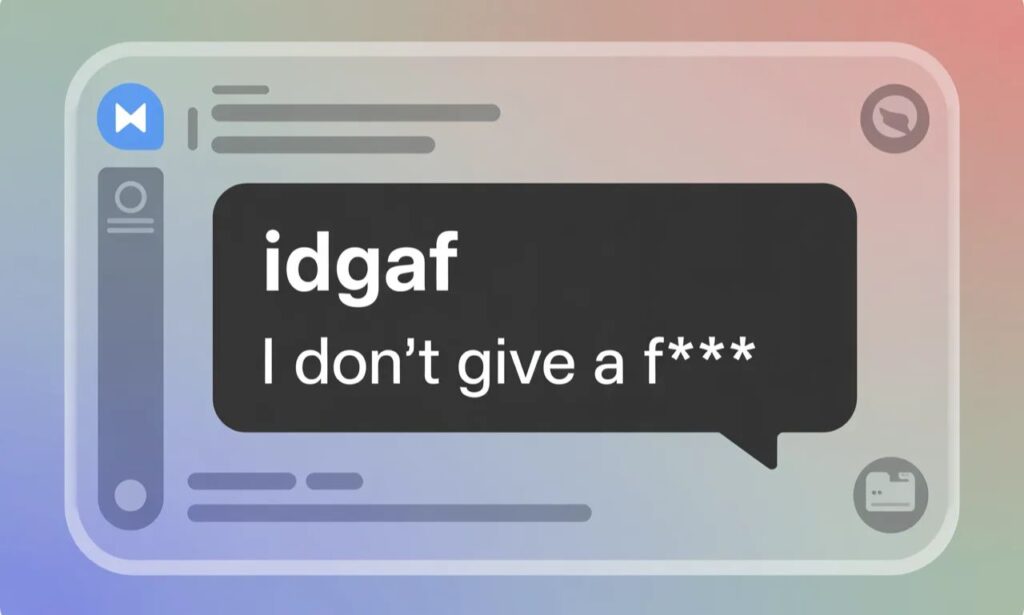
Ever felt lost when someone drops a random acronym in the middle of a text? You are definitely not alone. When you see someone mention the IDGAF Full Form in Chat, they are basically saying “I don’t give a f***.” It is a popular slang used across social media platforms like Instagram and WhatsApp to show a carefree attitude or total indifference toward a specific situation.
Ever wondered why some people seem so unbothered during a heated debate online? They usually deploy this viral acronym as a power move. It is the ultimate shortcut for digital communication when you want to signal that you are done with the drama. Understanding these texting trends is the best way to keep your online conversations sharp and trendy.
In short, using this shorthand helps you stay relatable in modern messaging. Whether you are gen-z or just tech-savvy, knowing the context of informal language is key. It keeps your chatting style feeling authentic and effortless while navigating digital spaces with total confidence.
What Does IDGAF Mean in Chat?
In the fast-paced realm of instant messaging, users frequently seek the most efficient way to express complex emotions. The term is a direct abbreviation for a phrase expressing total nonchalance or a lack of concern. When you see these five letters appear on your screen, the sender is effectively signaling that they have no emotional investment in the topic at hand.
In 2026, this term has become a staple of digital linguistics. It isn’t just a response; it is a “vibe” that characterizes a person who is unbothered by external opinions or drama. While it originated in the early days of chat rooms, its staying power in the modern lexicon is due to its raw honesty and the clear boundary it sets between the speaker and the subject matter.
IDGAF Full Form Explained
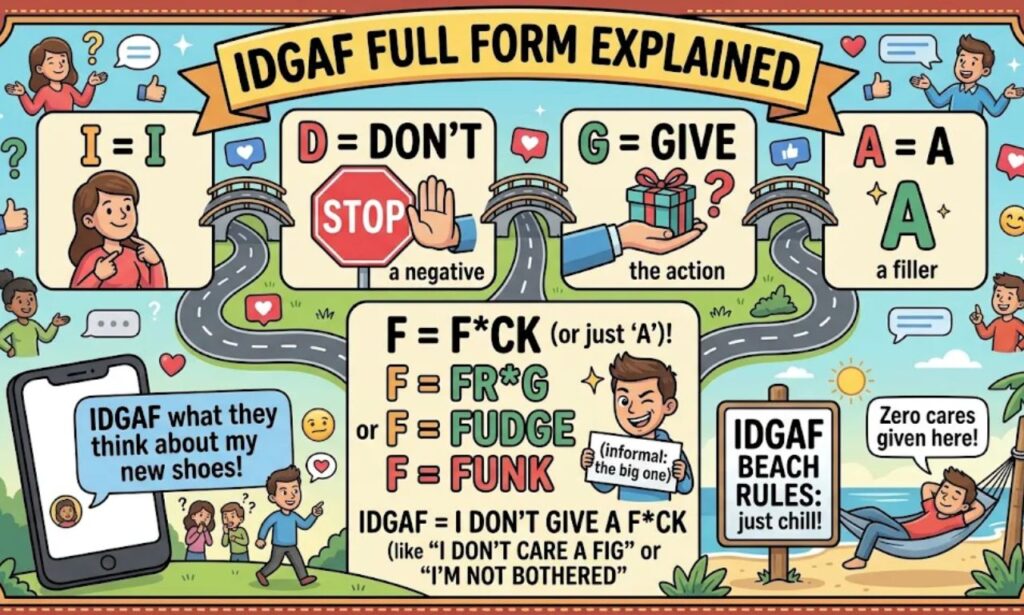
The literal shorthand stands for “I Don’t Give A F***.” Because it contains a strong profanity, it is inherently more aggressive than many other common acronyms. Understanding the full form is crucial because it helps you gauge the “temperature” of a conversation. If someone chooses this specific abbreviation over a softer alternative, they are likely feeling a high level of frustration or extreme indifference.
The mechanics of the phrase allow it to function as a complete sentence. In many texting apps, a single “IDGAF” can end a debate instantly. It is an assertive linguistic tool that leaves no room for ambiguity. By using the first letters of each word, the user maintains the intensity of the original phrase while adhering to the shorter character limits and rapid-fire nature of mobile messaging.
The Real Meaning of IDGAF in Text Messages
Beyond the literal translation, the “real” meaning of this term often relates to personal empowerment and mental health. In the context of 2026 digital culture, saying you don’t care is often a way to protect your peace. It signifies that you are choosing not to let a viral trend, a negative comment, or an unnecessary argument affect your mood.
When used in private messages, it can also serve as a form of hyperbole. For instance, if a friend asks what you want for dinner and you reply with this acronym, you aren’t actually being hostile; you are simply stating that you have zero preference and are happy with any choice. This contextual flexibility is why the term remains a top-ranking piece of slang vocabulary.
Why People Use IDGAF in Online Chats
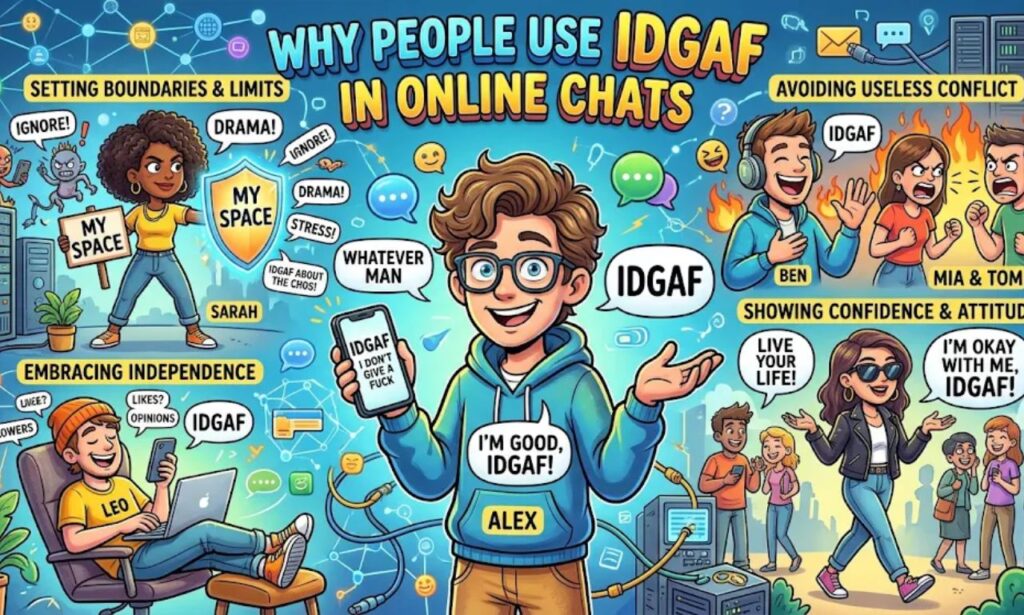
The primary driver for using this abbreviation is emotional efficiency. We live in an era of information overload, where we are constantly prompted to have an opinion on everything. Using this viral acronym allows a user to “opt-out” of a conversation without needing to provide a detailed explanation. It is a time-saver that matches the user intent of staying detached.
Furthermore, it acts as a social lubricant among certain groups. Among close friends, it can be a sign of authenticity. It shows that you don’t feel the need to “perform” or be overly polite. In the online environment, being seen as “unbothered” is often equated with high social status, making this phrase a popular choice for those looking to project confidence.
IDGAF Meaning in Social Media Conversations
On platforms like Instagram, TikTok, and X, the term often appears in captions or as a hashtag. Here, its meaning shifts slightly toward the “aesthetic” of being a rebel or a lone wolf. It is used to accompany photos where the individual is ignoring traditional fashion rules or social norms.
In public comment sections, the usage is more defensive. It is a common retort to “trolls” or “haters.” By replying with this shorthand, a creator shows their followers that they are not bothered by negativity. This helps maintain a positive brand image by demonstrating that the creator is focused on their own path rather than the noise of the internet subcultures.
IDGAF vs IDC vs I Don’t Care — What’s the Difference?
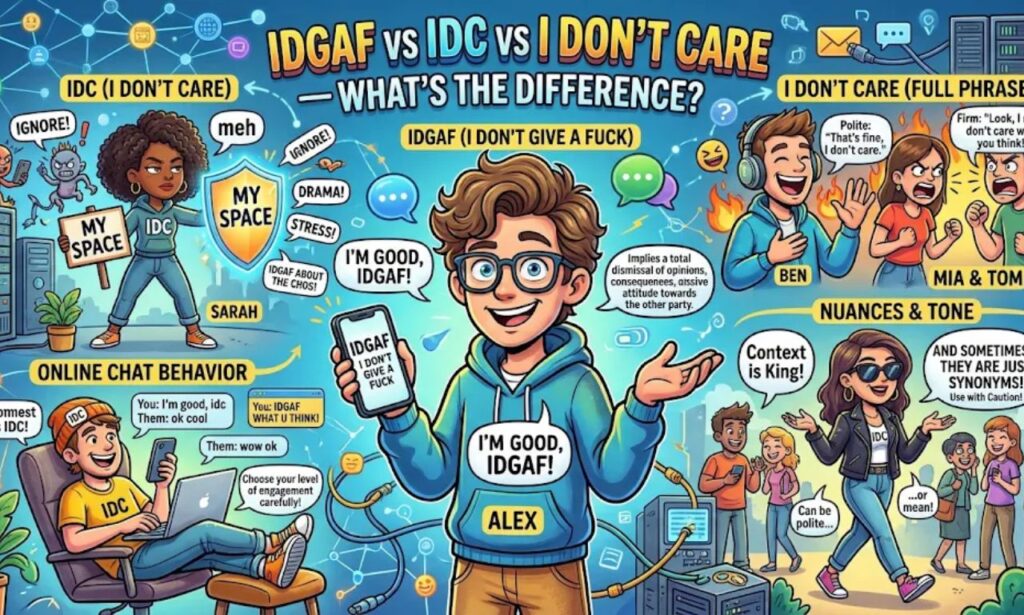
While these phrases all express a lack of concern, they carry different “semantic weights” and tonal delivery. Choosing the wrong one can lead to miscommunication or unnecessary tension.
| Term | Full Form | Intensity Level | Best Context |
| I Don’t Care | N/A | Low/Medium | Formal or semi-formal verbal speech. |
| IDC | I Don’t Care | Medium | Casual texting with acquaintances. |
| IDGAF | I Don’t Give A F*** | High/Aggressive | Close friends or heated arguments. |
IDC is the “polite” version of the acronym. It is safe for most casual conversations where you want to show you are flexible. However, the IDGAF Full Form in Chat adds a layer of “edge” and finality that the other options lack. It is the “nuclear option” of indifference.
When to Use IDGAF in Chat
See more : CMP People Meaning: What Does CMP Mean in Text, Social Media, and Online Chats?
Knowing when to deploy this viral acronym is an art form in digital communication. It is most effective when:
- You are talking to best friends who understand your humor.
- You are being hounded by someone whose opinion you genuinely do not value.
- You are expressing a funny, exaggerated level of apathy toward a trivial topic (like a celebrity breakup).
- You are participating in a meme or a specific social media trend.
When You Should Avoid Using IDGAF
There are several scenarios where using this shorthand can backfire significantly:
- Professional Environments: Never use this in Slack, Microsoft Teams, or emails. It is seen as unprofessional and highly disrespectful.
- Sensitive Topics: If someone is sharing a personal struggle or serious news, responding with this is incredibly “tone-deaf” and cruel.
- With Elders: Most people from older generations find the underlying profanity offensive, regardless of the abbreviation.
- Customer Service: Using this with a client or service provider will likely result in a breakdown of the business relationship.
Is IDGAF Rude or Offensive?
The answer depends entirely on audience perception and contextual relevance. Because the Full Form includes a swear word, it is technically classified as profanity. In a strict or conservative setting, it is absolutely considered rude. However, in the informal language of 2026, many young people view it as a neutral term of expression rather than a direct insult.
The “offensiveness” often comes from the perceived dismissiveness. If you use it to shut down someone who is trying to be helpful, it will be viewed as an attack. If you use it to describe your own feelings about a movie, it is harmless.
IDGAF Meaning in Different Contexts
The phrase shifts meaning based on the social dynamics of the digital space. In 2026, it acts as a contextual tool for boundary setting. Whether expressing humorous apathy or genuine frustration, understanding the “vibe” is essential for maintaining authentic and effective communication online.
IDGAF in Casual Conversations
In a low-stakes chat log, it usually means “I have no preference.”
Example: “Do you want pizza or tacos?” “IDGAF, you pick!”
IDGAF in Arguments
In a heated debate, it is used to de-escalate (or further provoke) by showing that the opponent’s points are not landing. It signals that the user is no longer listening.
IDGAF in Funny Conversations
Often used in memes to describe relatable situations where one simply gives up, like trying to fold a fitted sheet or following a complex recipe.
IDGAF in Social Media Comments
This is the “shield” of the content creator. It is a way to tell the public audience that their criticism has no power.
Examples of IDGAF in Chat
To better understand the user intent, let’s look at some common texting scenarios:
- The “Whatever” Vibe: “Teacher said we have extra homework.” -> “IDGAF, I’m not doing it anyway.”
- The “Empowered” Vibe: “Everyone is talking about your new haircut.” -> “IDGAF what they think, I love it.”
- The “Busy” Vibe: “Did you see the drama on the group chat?” -> “Nah, IDGAF about that stuff, I’m at the gym.”
IDGAF Meaning in Texting Among Friends
Among close peers, the term acts as a cultural signifier. It proves you are part of the “in-group” that uses current slang. It is rarely taken literally as “I hate you” or “I don’t care about you.” Instead, it is understood as “I don’t care about this specific thing we are talking about.”
IDGAF Meaning in Instagram, Snapchat, and WhatsApp
Each platform has a slightly different “dialect” for using the term:
- Instagram: Mostly used in reels and captions to look “cool” and detached.
- Snapchat: Used in quick snaps to show a “mood.”
- WhatsApp: Used in status updates or direct messages to friends.
How Young People Use IDGAF in 2026
The Gen-Z and Gen-Alpha demographics have turned the acronym into a badge of authenticity. In a world where everything feels “fake” or “over-produced,” being someone who “doesn’t give a f***” is seen as a way of being real. It is part of a larger trend of digital stoicism, where young people are becoming more selective about where they direct their emotional energy.
Alternative Slang Words Similar to IDGAF
If you want to express indifference but feel this term is too strong, consider these LSI keywords and phrases:
- IDC: (I Don’t Care) – The standard neutral version.
- WTV: (Whatever) – A classic dismissive term.
- Meh: (A sound of indifference) – Perfect for when you can’t even be bothered to type an acronym.
- NBD: (No Big Deal) – Focuses on the lack of importance of the event.
Polite Alternatives to IDGAF
For professional communication or when talking to people you don’t know well, use these relatable alternatives:
- “I’m flexible on this.”
- “I don’t have a strong preference.”
- “Whatever works best for the group.”
- “I’m not particularly concerned about that.”
Funny Ways People Use IDGAF
Beyond the standard replies, the acronym has carved out a niche in the world of internet memes as a way to highlight the absurdity of life. In 2026, it is common to see people using this shorthand to caption photos of inanimate objects or animals in ridiculous situations—like a pigeon staring down a high-speed train or a laptop screen displaying a “critical error” while the owner calmly drinks coffee. This comedic delivery turns a potentially aggressive phrase into a relatable moment of shared human experience, proving that sometimes, the only logical response to a chaotic digital environment is a healthy dose of satirical indifference.
Another hilarious trend involves using the viral acronym to describe “low-stakes rebellions” that everyone secretly enjoys. You’ll find users posting about wearing mismatched socks to a formal event or eating breakfast cereal for dinner, accompanied by the IDGAF Full Form in Chat. By applying such an assertive and intense phrase to completely harmless activities, it creates a “vibe” of mock-toughness. This playful irony is a staple of Gen-Z humor, where the goal is to be as unbothered as possible about things that don’t actually matter, keeping the online conversation lighthearted and authentic.
Frequently Asked Questions
1. What is the IDGAF full form in chat?
It stands for “I Don’t Give A F***,” a viral acronym used in digital communication to show a total lack of concern or interest.
2. Is using IDGAF considered rude?
Yes, it can be offensive due to the inherent profanity. It is best kept for casual conversations among close friends or peers online.
3. What is a polite alternative to IDGAF?
You can use IDC or “I don’t have a preference” to stay professional while still conveying indifference in modern messaging and workspaces.
4. How do young people use IDGAF in 2026?
Gen-Z uses it as a power move to signal they are unbothered by social media drama or toxic trends, prioritizing their mental health.
5. Can I use IDGAF in business emails?
No, it is highly unprofessional. Stick to formal language and avoid informal slang to maintain a positive brand image and professional reputation always.

Abu Bakar is a meaning-focused content writer specializing in names, word definitions, phrases, and symbolic interpretations. He focuses on researching origins, explaining concepts, and presenting clear, engaging information that helps readers understand the deeper meanings behind everyday words.
Connect with Me on: Facebook