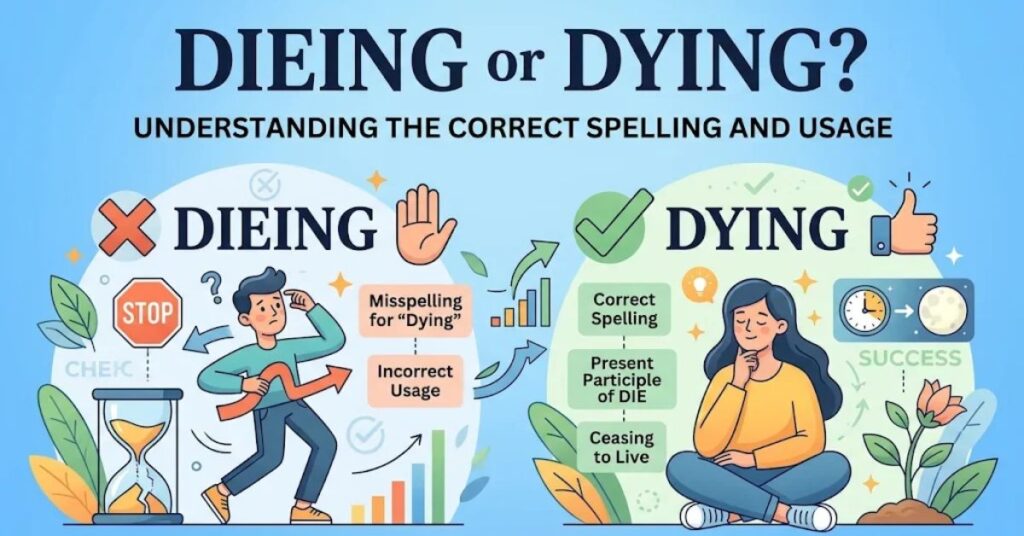
Have you ever stopped while writing because you weren’t sure whether to use dieing or dying? You’re not alone. These two spellings look almost identical, but only one works in everyday English. The confusion comes from a common spelling rule that changes how certain verbs form their -ing endings. Even experienced writers sometimes get this wrong.
Understanding dieing or dying becomes easier when you know what each word means and where it belongs. The difference matters in school assignments, emails, professional documents, and casual conversations. In this guide, you’ll learn the correct spelling, pronunciation, grammar rules, and practical examples. You’ll also discover why dieing has a rare technical meaning and how to avoid confusing it with dyeing. By the end, choosing the right word will feel much more natural.
Quick Answer :Dieing or Dying
Dying is the correct spelling when you talk about death, something approaching its end, or something gradually losing strength. It is the present participle and gerund form of the verb die.
Dieing is generally incorrect in everyday English. However, it sometimes appears in specialized manufacturing contexts involving industrial dies.
Here is a quick comparison:
| Word | Meaning | Usage |
|---|---|---|
| Dying | Approaching death or ending | Correct everyday spelling |
| Dieing | Rare manufacturing-related term | Specialized usage |
| Dyeing | Adding color to something | Correct spelling for coloring |
For example, write My phone battery is dying rather than My phone battery is dieing.
Featured Snippet Answer
The correct spelling is dying when referring to death, approaching the end of life, or something gradually stopping. English changes the letters ie to y before adding -ing. Therefore, die becomes dying, not dieing. The spelling dieing is generally incorrect in everyday writing, although it has a rare technical connection to manufacturing dies.
What Is the Difference Between Dieing and Dying?
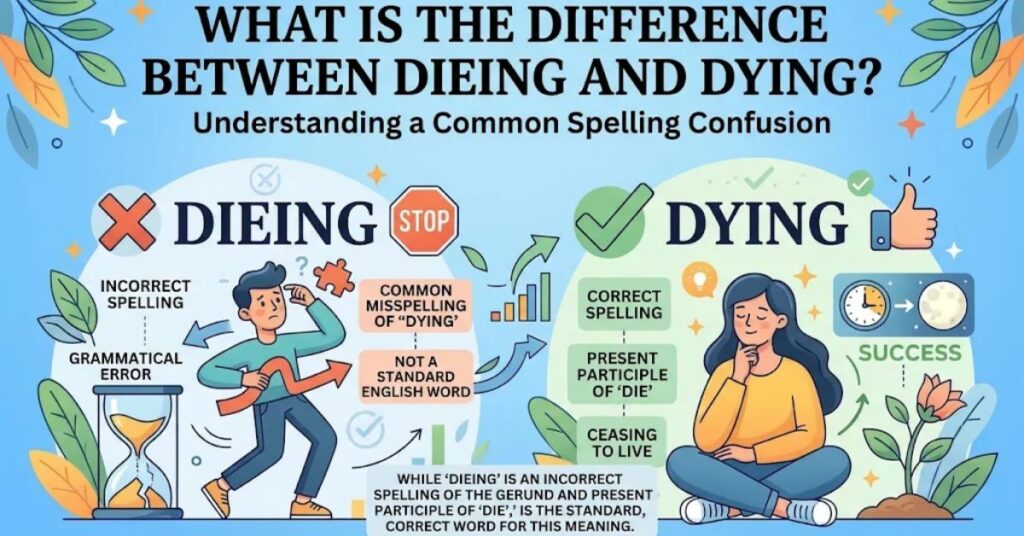
The main difference involves meaning and grammatical usage. Dying comes from the verb die and describes the process of losing life or gradually coming to an end.
Dieing has a much narrower technical association with manufacturing. It relates to working with a die, which is a tool used to cut, shape, or stamp materials.
Consider these examples:
- The old tree is dying because nobody waters it.
- My laptop battery is dying.
- The factory uses specialized equipment for dieing metal components.
The first two sentences describe something approaching its end. The third uses a specialized manufacturing term.
Side-by-Side Comparison
| Feature | Dying | Dieing |
|---|---|---|
| Common usage | Very common | Extremely rare |
| Related word | Die | Manufacturing die |
| Refers to death | Yes | No |
| Present participle of die | Yes | No |
| Everyday English | Correct | Usually incorrect |
| Industrial context | No | Possible |
What Does Dying Mean?
Dying describes the process of approaching death or gradually losing the ability to function. It can refer to people, animals, plants, and even nonliving things.
For example, a person may be dying because of a serious illness. A flower can also be dying when it doesn’t receive enough sunlight or water.
English speakers also use dying figuratively. When someone says a tradition is dying out, they mean fewer people follow it.
Common situations involving dying include:
- A person approaching the end of life.
- Plants losing their health.
- Animals nearing death.
- A phone battery losing power.
- Traditions gradually disappearing.
- A fire becoming weaker.
The meaning depends on the surrounding sentence.
Dying Definition
Dying is the present participle and gerund form of the verb die. It describes the process of stopping living or gradually coming to an end.
According to its context, dying can have several meanings:
- Losing life: A person or animal is approaching death.
- Stopping functioning: A machine or electronic device is losing power.
- Disappearing: A tradition, language, or custom is becoming less common.
- Becoming weaker: A fire or sound is gradually fading.
For example, the sentence The fire is dying down describes a fire that is becoming less intense.
Dying Pronunciation
The word dying has two syllables and is pronounced:
/ˈdaɪ.ɪŋ/
It sounds like DYE-ing.
The pronunciation sometimes causes spelling confusion because the word begins with the same letters as die. However, its spelling changes when you add the -ing ending.
You can practice saying it naturally:
- The flowers are dying.
- His phone is dying.
- The patient is dying.
Remember that the correct spelling always uses a Y before the final -ing.
Examples of Dying in Sentences
Examples make the meaning of a word easier to understand. Dying appears in many everyday situations, including conversations about health, nature, technology, and relationships.
Here are some practical examples:
- The flowers are dying because they need fresh water.
- My phone battery is dying, so I need a charger.
- The patient was dying when the emergency team arrived.
- Many old traditions are slowly dying out.
- The fire is dying down after several hours.
- Some endangered species are dying because of habitat loss.
- The business is dying due to poor management.
Each sentence uses dying to describe death, decline, or something approaching its end.
Figurative Uses of Dying
People often use dying without referring to actual death. In informal English, it can express a strong feeling, desire, or reaction.
For example:
- I’m dying to know what happened.
- She’s dying for a cup of coffee.
- We were dying of laughter after hearing that joke.
- He is dying to meet his favorite singer.
These expressions make everyday conversations more emotional and natural. They don’t usually describe a literal life-threatening situation.
What Does Dieing Mean?
Dieing is an uncommon spelling associated with manufacturing terminology. It relates to a manufacturing die, which is a specialized tool used to shape, cut, or stamp materials.
However, most people encounter this spelling because they mistakenly use it instead of dying.
For example:
- Incorrect: The plant is dieing.
- Correct: The plant is dying.
The distinction becomes important when you write about everyday situations. If you’re discussing death, fading energy, or something ending, use dying.
Dieing should only appear when the technical context genuinely requires it. Even then, check the terminology used in your particular industry.
Is Dieing a Real Word?
Yes, dieing can appear as a specialized technical term. However, it isn’t the correct present participle of the everyday verb die.
This distinction explains why dictionaries and writing tools may treat the word differently depending on context.
Most readers searching for dieing are trying to understand whether it can replace dying. In ordinary English, the answer is no.
For example:
- The battery is dying.
- The flowers are dying.
- The animal is dying.
Writing dieing in these sentences would be a spelling error. If you’re writing an everyday email, article, school assignment, or social media post, choose dying.
Read More :What Does EMD Meaning in Text? Meaning, Slang & Examples
Manufacturing Meaning of Dieing
In manufacturing, a die is a tool that cuts, shapes, or stamps materials into specific forms. Industries use these tools to produce metal parts, plastic components, and other products.
The term dieing may appear in specialized discussions about operations involving manufacturing dies. However, technical vocabulary can vary between industries, so writers should follow the terminology used in their field.
A manufacturing die can perform several functions:
- Cutting metal sheets into shapes.
- Stamping designs onto materials.
- Forming industrial components.
- Creating specific product dimensions.
This technical meaning has little connection with death. That’s why dieing remains uncommon in general writing.
Examples of Dieing in Sentences
Because dieing has a specialized meaning, examples should clearly show its manufacturing context.
Consider these sentences:
- The factory is dieing metal sheets using precision equipment.
- Workers monitored the dieing operation during production.
- The manufacturing team discussed improvements to the dieing process.
These examples illustrate the intended technical usage rather than the everyday verb die.
However, manufacturing terminology differs across industries. Some professionals may prefer alternative terms such as stamping, cutting, or die processing.
For ordinary communication, avoid using dieing when you mean something is approaching its end.
Why Is Dying Spelled With a Y Instead of IE?
The spelling of dying follows a standard English spelling pattern. When certain verbs end in -ie, English changes those letters to Y before adding -ing.
This is why die becomes dying instead of dieing.
The same pattern appears in other common verbs, including lie and tie. Although the change might seem unusual at first, it makes the spelling easier to recognize and follow.
Compare these examples:
- Die becomes dying.
- Lie becomes lying.
- Tie becomes tying.
Once you understand this pattern, remembering the correct spelling becomes much easier.
The English Grammar Rule
English follows a useful spelling rule for verbs ending in -ie. When you add the -ing suffix, replace the final -ie with Y.
The basic pattern looks like this:
Verb ending in -ie → Replace -ie with Y → Add -ing
For example:
| Base Verb | Incorrect Form | Correct Form |
|---|---|---|
| Die | Dieing | Dying |
| Lie | Lieing | Lying |
| Tie | Tieing | Tying |
This rule helps prevent incorrect combinations when forming present participles and gerunds.
It is a small spelling change, but it makes a noticeable difference in written English.
Why Die Becomes Dying
The verb die contains the letters -ie at the end. When you add -ing, English replaces those letters with Y.
The transformation looks like this:
- Original verb: Die
- Remove the final -ie.
- Add Y.
- Attach -ing.
- Final word: Dying.
This process follows the same spelling pattern used in lying and tying.
A common mistake is to add -ing directly to die. That creates dieing, which isn’t the standard form of the verb.
Understanding the transformation helps you avoid this mistake without relying on spell-checking tools.
Similar Examples
Other English verbs follow the same IE-to-Y spelling pattern. Learning these examples can help you remember the correct form of dying.
Lie → Lying
The verb lie changes to lying when you add -ing.
Examples:
- He is lying on the couch.
- The dog is lying beside the door.
- She was lying about the situation.
The incorrect spelling is lieing. Remember that the final -ie changes to Y before adding -ing.
Tie → Tying
The verb tie follows the same pattern.
Examples:
- She is tying her shoes.
- He is tying a ribbon around the gift.
- They are tying the packages together.
The correct spelling is tying, not tieing.
These examples reinforce the same grammar rule. When a verb ends in -ie, change it to Y before adding -ing.
Die Verb Forms Explained
Learning the different forms of die makes it easier to understand how the word changes in sentences.
Like other English verbs, die has several forms depending on tense and grammatical structure.
Here are its main forms:
- Base form: Die
- Third-person singular: Dies
- Simple past: Died
- Past participle: Died
- Present participle: Dying
You use these forms to describe different times and situations.
For example, I may die someday uses the base form. She dies in the story uses the third-person singular form.
Meanwhile, The plant died last week describes a completed action. The leaves are dying describes something happening now.
Verb Forms Table
The following table summarizes the main forms of the verb die.
| Verb Form | Correct Word |
|---|---|
| Base form | Die |
| Third-person singular | Dies |
| Past tense | Died |
| Past participle | Died |
| Present participle | Dying |
| Gerund | Dying |
Understanding these forms helps you choose the correct word when writing about past, present, and ongoing situations.
Examples
Here are simple sentences showing how each verb form works:
- Die: Everyone will die someday.
- Dies: The main character dies at the end.
- Died: My grandfather’s favorite tree died last winter.
- Died: Several plants have died because of the heat.
- Dying: The flowers are dying without water.
Notice that only the present participle uses the changed spelling dying.
Dieing vs Dying vs Dyeing
Another common spelling confusion involves dyeing. All three words look similar, but they have different meanings.
Dying relates to death or something gradually ending. Dieing has a rare manufacturing connection. Dyeing means adding color to something.
For example, imagine someone discussing three different situations:
- Their garden flowers are dying.
- A factory is working with metal dies.
- Their sister is dyeing her hair.
Each sentence requires a different word.
Understanding these distinctions prevents spelling mistakes and makes your writing clearer. Pay attention to the meaning before choosing a spelling.
Comparison Table
Use this table to understand the difference between all three words.
| Word | Meaning | Example |
|---|---|---|
| Dying | Approaching death or ending | The flowers are dying. |
| Dieing | Manufacturing-related activity | The factory is dieing metal sheets. |
| Dyeing | Adding color | She is dyeing her hair. |
The easiest way to remember them is to connect each word with its meaning.
- Dying = Death or ending.
- Dieing = Manufacturing die.
- Dyeing = Coloring something.
How to Avoid Confusing Them
The easiest way to avoid confusion is to understand what you’re trying to describe. Don’t choose a spelling simply because it looks familiar.
Ask yourself whether you’re discussing death, manufacturing, or adding color.
Here is a simple approach:
- Use dying for death, decline, or something ending.
- Use dyeing when someone colors fabric, hair, or another material.
- Use dieing only when a specialized manufacturing context requires it.
This quick check works for most everyday writing situations.
Examples
Compare these sentences:
- The flowers are dying in the summer heat.
- My sister is dyeing her hair brown.
- The factory uses dies to shape metal components.
The meaning changes completely depending on the word. Choosing carefully helps your readers understand exactly what you mean.
Common Mistakes With Dieing and Dying
Many writers make spelling mistakes because they assume that adding -ing means keeping the original word unchanged.
This assumption seems reasonable, but English has different spelling patterns for different verbs.
The most common mistake involves using dieing instead of dying. You might see it in text messages, school assignments, online posts, or professional emails.
Here are some typical errors:
- My phone is dieing.
- The flowers are dieing.
- He is dieing of laughter.
- That tradition is dieing out.
Each sentence needs dying instead.
Learning the correct spelling rule can help you avoid these mistakes in future writing.
Writing Errors
Understanding incorrect and correct examples is one of the easiest ways to improve spelling.
Incorrect
These sentences contain the wrong spelling when referring to death or decline:
- My phone battery is dieing.
- The flowers are dieing.
- The patient is dieing.
- He is dieing of laughter.
- The old tradition is dieing out.
Correct
Here are the corrected versions:
- My phone battery is dying.
- The flowers are dying.
- The patient is dying.
- He is dying of laughter.
- The old tradition is dying out.
Notice how replacing dieing with dying fixes every sentence. The meaning stays the same, but the spelling becomes correct.
Why the Mistake Happens
The confusion happens because writers naturally try to add -ing directly to the base verb die.
They assume the spelling should follow this pattern:
Die + ing = Dieing
However, English uses a different rule for verbs ending in -ie.
Instead, the final letters change before the suffix appears:
Die → Dying
This pattern also explains why we write lying instead of lieing and tying instead of tieing.
Another reason for confusion is the similar appearance of dying and dyeing. Both words sound alike, but their meanings differ.
Once you understand these spelling patterns, choosing the correct word becomes much easier.
How to Remember the Correct Spelling
You don’t need to memorize complicated grammar explanations to spell dying correctly. A simple comparison and a quick meaning check can help.
Start by remembering that die changes to dying, just like lie changes to lying.
You can also ask yourself what the sentence describes. If it involves death, something fading, or something losing power, dying is usually correct.
Try using these simple memory tricks whenever you’re writing:
- Remember the IE-to-Y spelling pattern.
- Connect dying with the verb die.
- Compare dying with lying and tying.
- Check whether the sentence describes death or coloring.
A little practice makes the correct spelling easier to remember.
Memory Trick #1
Think about these three related words:
- Die → Dying
- Lie → Lying
- Tie → Tying
All three follow the same spelling pattern. Their final -ie changes to Y before adding -ing.
For example, if you already know that lying is correct, you can use the same logic to remember dying.
Whenever you’re unsure, compare the words side by side.
This simple trick works especially well for students and English learners who frequently confuse similar spellings.
Memory Trick #2
Ask yourself one simple question:
Am I talking about death, something ending, or something losing strength?
If the answer is yes, you probably need dying.
For example:
- The battery is dying.
- The flowers are dying.
- The fire is dying down.
- The language is slowly dying out.
However, if you’re talking about changing the color of something, use dyeing.
This meaning-based trick helps you choose the correct spelling without remembering every grammar detail.
Common Expressions Using Dying
Dying appears in several popular English expressions. These phrases often describe strong emotions rather than actual death.
You might hear them in conversations, movies, social media posts, and everyday messages.
Some common expressions include:
- Dying to know.
- Dying for something.
- Dying of laughter.
Each phrase has a slightly different meaning. Understanding these expressions helps you use dying naturally in spoken and written English.
Dying to Know
The expression dying to know means being extremely curious about something. People use it when they strongly want to learn information or discover what happened.
Examples:
- I’m dying to know who won the competition.
- She’s dying to know the surprise.
- We are dying to know what happened yesterday.
This phrase is informal and common in everyday conversations.
It doesn’t suggest actual danger. Instead, it emphasizes curiosity and excitement.
Dying for Something
Dying for something means wanting it very badly. People often use this expression when talking about food, drinks, comfort, or experiences.
Examples:
- I’m dying for a cold drink.
- She’s dying for a vacation.
- He is dying for some good news.
- We’re dying for a relaxing weekend.
The phrase adds emotion and emphasis to ordinary statements.
It is especially common in casual conversations and friendly messages.
Dying of Laughter
Dying of laughter describes laughing extremely hard. People use it when something is so funny that they cannot stop laughing.
Examples:
- We were dying of laughter after watching the comedy.
- Everyone was dying of laughter at his joke.
- My friends were dying of laughter during the game.
This is a figurative expression rather than a literal description of death.
It makes conversations more expressive and helps communicate strong reactions.
When Should You Use Dying?
Use dying whenever you want to describe someone or something approaching death, gradually disappearing, or losing strength.
The word works in casual conversations, professional documents, academic writing, and creative stories.
You can use it for:
- People and animals approaching death.
- Plants losing their health.
- Batteries running out of power.
- Fires becoming weaker.
- Traditions disappearing.
- Businesses losing activity.
- Languages becoming less common.
For example, The old language is dying out describes a language that fewer people speak.
The important point is to use dying when your sentence relates to the verb die.
Everyday English
In everyday English, dying appears in conversations about health, technology, nature, and emotions.
You might say:
- My phone is dying. Can I borrow your charger?
- These flowers are dying without water.
- I’m dying to see the new movie.
- The fire is dying down.
These sentences show how flexible the word can be.
Dying also appears in informal expressions such as dying of laughter and dying for coffee.
Whether you’re sending a text message or chatting with a friend, dying is the correct spelling for these situations.
Formal Writing
Dying is also the standard spelling in formal communication. You should use it in academic assignments, business documents, news reports, and professional articles.
For example:
- Several endangered species are dying because of habitat destruction.
- The patient was dying from serious complications.
- Some traditional languages are slowly dying out.
Correct spelling improves clarity and makes your writing look professional.
Avoid using dieing when you mean dying. Even a small spelling mistake can distract readers and weaken an otherwise well-written document.
Creative Writing
Writers frequently use dying in fiction, poetry, storytelling, and descriptive passages.
It can describe literal death or create emotional imagery. For example, a writer might describe a dying kingdom after years of conflict.
Other examples include:
- The dying sun disappeared behind the mountains.
- Her hopes were slowly dying.
- The kingdom was dying after years of war.
- He was dying to hear the truth.
These examples show how the word adds emotion and atmosphere to creative writing.
Quick Grammar Checklist for Writers
Before publishing your writing, take a moment to check how you’ve used dying.
A quick review can prevent common spelling errors.
Use this checklist:
- Are you describing death or something ending?
- Did you write dying instead of dieing?
- Are you confusing dying with dyeing?
- Did you follow the IE-to-Y spelling rule?
- Does the word fit the meaning of your sentence?
- Have you checked your writing for other spelling mistakes?
If your sentence describes death or decline, dying is generally the correct choice.
Common Mistakes and Corrections
Here is a quick reference table showing common spelling errors and their corrections.
| Incorrect | Correct |
|---|---|
| Dieing plant | Dying plant |
| Dieing battery | Dying battery |
| Dieing out | Dying out |
| Dieing of laughter | Dying of laughter |
| Dieing species | Dying species |
| Dieing patient | Dying patient |
| Dieing fire | Dying fire |
| Dieing tradition | Dying tradition |
Remember that these corrections apply when you mean the ordinary verb die.
The technical manufacturing context is different, so always consider the intended meaning before choosing a word.
Frequently Asked Questions
Is it dieing or dying?
Dying is correct when referring to death, decline, or something ending. Dieing is generally incorrect in everyday English.
Why is dying spelled with y?
English changes the final -ie to Y before adding -ing. Therefore, die becomes dying instead of dieing.
Is dieing a real word?
Dieing can appear in specialized manufacturing terminology involving industrial dies. However, it isn’t the correct form of the verb die.
What is the present participle of die?
The present participle of die is dying. It describes an ongoing action or process involving death or decline.
What is the difference between dying and dyeing?
Dying relates to death or ending, while dyeing means adding color to hair, fabric, or other materials.
How do you spell dying correctly?
The correct spelling is D-Y-I-N-G. Remember to replace the final -ie in die with Y before adding -ing.
Why Does Die Become Dying?
Die becomes dying because English changes the final -ie to Y before adding the -ing suffix. The same pattern appears in lying and tying.
Can Dieing Ever Be Correct?
Yes. Dieing has a rare technical association with manufacturing dies. However, dying is the correct spelling in almost all everyday situations.
Final Verdict: Dieing vs Dying
Choosing between dieing and dying becomes simple once you understand the spelling rule. Dying is the correct form of the verb die when discussing death, fading energy, or something gradually coming to an end. The final -ie changes to Y before adding -ing. This same pattern appears in words like lying and tying. Although dieing has a rare connection to manufacturing terminology, it isn’t suitable for ordinary writing. You should also remember dyeing, which means adding color to hair, fabric, or other materials.
Whenever you’re unsure about dieing or dying, look at the meaning of your sentence. If you’re describing death, decline, or something losing strength, choose dying. If you’re talking about coloring, use dyeing instead. Keep these simple distinctions in mind when writing emails, articles, assignments, or everyday messages. A small spelling rule can make a big difference in clear communication. Practice these examples, and you’ll soon choose the correct word without hesitation.

Abu Bakar is a meaning-focused content writer specializing in names, word definitions, phrases, and symbolic interpretations. He focuses on researching origins, explaining concepts, and presenting clear, engaging information that helps readers understand the deeper meanings behind everyday words.
Connect with Me on: Facebook