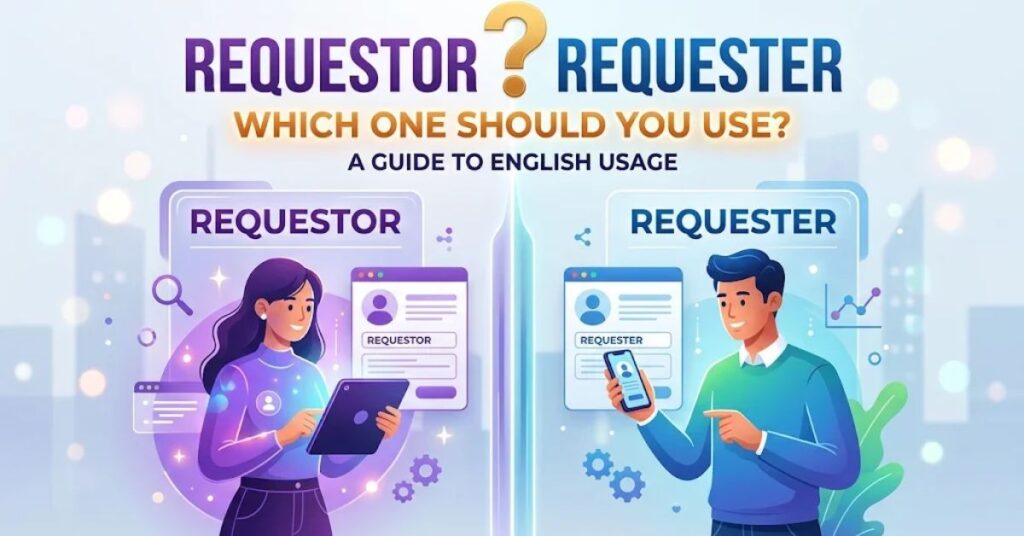
Have you ever paused while writing an email or filling out a form because you weren’t sure whether to type requester or requestor? You’re not alone. These two spellings look almost identical, and both appear in professional documents, workplace communication, and online systems. However, one spelling is much more common than the other.
When comparing requestor or requester, the main difference comes down to usage rather than meaning. Both words describe someone who makes a request, but they don’t appear equally often in everyday English. This guide explains their definitions, spelling patterns, common differences, and industry-specific uses. You’ll also find practical sentence examples and simple tips to help you choose the right spelling whenever you write.
Quick Answer:Requestor or Requester
Both requester and requestor are correct English words. They describe a person who asks for something, submits a request, or seeks an action from another person or organization.
However, requester is the more common choice in modern American English. You’ll see it in everyday communication, business emails, articles, and academic writing.
Requestor appears less frequently but remains useful in specialized settings, including legal documents, procurement systems, and IT service management platforms.
Here’s the easiest way to remember:
- Requester: The preferred spelling for general and professional writing.
- Requestor: An accepted alternative often used in specialized industries.
- Meaning: Both words describe someone who makes a request.
If you’re unsure, choose requester. It’s familiar to most readers and works in almost every general writing situation.
Featured Snippet Answer
Requester and requestor both mean a person who makes a request. The difference is their spelling preference and frequency of use. Requester is the more common form in modern English, while requestor appears in certain legal, procurement, government, and IT environments. Both spellings are acceptable, but requester is generally the safer choice for everyday and professional communication.
Requester vs Requestor at a Glance
A quick comparison makes the difference easier to understand. Although these words share the same definition, their usage varies across different writing environments.
| Feature | Requester | Requestor |
|---|---|---|
| Meaning | Person making a request | Person making a request |
| Correct English Word | Yes | Yes |
| Word Type | Noun | Noun |
| Usage Frequency | More common | Less common |
| General Writing | Preferred | Less common |
| Business Communication | Widely used | Sometimes used |
| Legal Documents | Accepted | Also used |
| Procurement Systems | Used | Often preferred by some organizations |
| IT Service Management | Used | Common in some platforms |
| American English | Standard choice | Accepted alternative |
The biggest takeaway is simple: neither spelling changes the meaning. Your audience and the writing environment should guide your decision.
What Does Requester Mean?
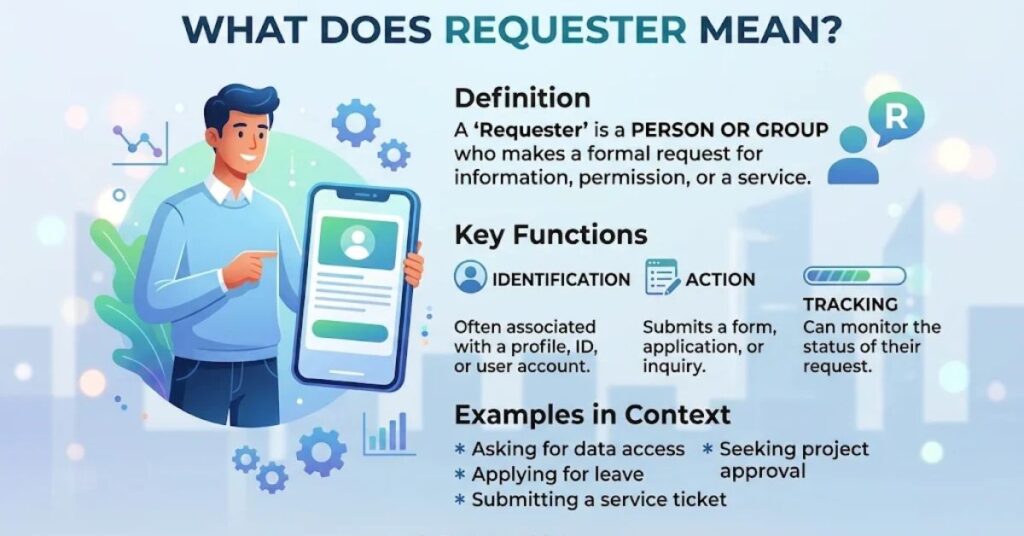
A requester is someone who asks for something or formally submits a request. The person might need information, assistance, approval, a service, or a particular action.
For example, imagine contacting a company’s customer support team because your account isn’t working. You’re the requester because you’ve asked the company to solve a problem.
The word appears in many everyday and professional situations, including:
- Customer service conversations
- Business emails
- Application forms
- Support tickets
- Research and academic documents
- Workplace reports
Requester follows a familiar English spelling pattern. Adding the suffix -er to request creates a noun describing the person performing the action.
Requester Definition
Requester (noun): A person who asks for something, seeks information, or formally submits a request.
The word comes from the verb request. Its ending follows the common English pattern of adding -er to describe someone performing an action.
Similar examples include:
- Teach → Teacher
- Drive → Driver
- Write → Writer
- Read → Reader
- Request → Requester
You can use requester whenever someone initiates a request. The term doesn’t necessarily mean the person will receive approval. It only identifies the individual who asks for something.
Requester Examples
Here are some practical examples showing how requester works in everyday and professional English:
- The requester submitted a support ticket yesterday.
- Every requester must complete the registration form.
- The company contacted the requester for additional information.
- The requester received a confirmation email.
- Our manager approved the requester’s proposal.
- The requester asked for a copy of the report.
These examples show how naturally the word fits different situations. Whether someone needs information or workplace assistance, requester clearly identifies the person making the request.
What Does Requestor Mean?
A requestor is also a person who makes a request. Its definition is almost identical to requester, so the two words can often replace each other without changing a sentence’s meaning.
However, requestor appears more frequently in certain specialized environments. For example, a procurement department might use this spelling when identifying employees who submit purchasing requests.
You may also encounter it in legal agreements, government forms, and IT service management software.
Although some readers consider requestor an incorrect spelling, that assumption isn’t accurate. It is an established English word. Its lower frequency simply makes it less familiar in everyday communication.
Requestor Definition
Requestor (noun): A person who formally asks for something or submits a request for information, approval, goods, or services.
The word uses the suffix -or instead of -er. Both endings can identify someone performing an action, although English doesn’t apply them uniformly.
In workplace environments, requestor often appears as a field name or role label. For example, an IT support system might display the requestor’s name alongside a ticket number and submission date.
The meaning remains the same. It identifies the individual who initiated the request.
Requestor Examples
Consider these sentences to understand how requestor appears in professional communication:
- The requestor must provide valid identification documents.
- The requestor approved the procurement request.
- The IT department notified the requestor about the ticket status.
- The requestor signed the legal agreement.
- The requestor received authorization from management.
- The requestor submitted the purchase requisition through the company portal.
Notice that each sentence identifies someone who asks for something. The spelling changes, but the basic meaning stays the same.
Requester vs Requestor: Key Differences
The main distinction between these words involves spelling preference and usage frequency. Neither word describes a completely different type of person.
Both identify someone who makes a request. However, requester appears more often in general English, while requestor has developed a place in certain professional and technical settings.
Let’s examine their differences more closely.
Meaning
There is no significant difference in meaning between requester and requestor.
Both words describe someone who asks for information, assistance, permission, or an action.
For example:
- The requester asked for additional information.
- The requestor asked for additional information.
Both sentences communicate exactly the same idea. The choice depends on the preferred spelling rather than the person’s responsibilities.
Spelling
The difference appears in the final letters of each word:
- Requester ends with -er.
- Requestor ends with -or.
These suffixes both appear in English nouns that identify people performing actions. However, their use depends on established spelling conventions.
Requester follows a familiar pattern found in words such as teacher, writer, and driver. Requestor follows a less common pattern associated with words such as actor, director, and auditor.
Usage Frequency
Requester is considerably more familiar in everyday English. It frequently appears in articles, websites, business correspondence, educational materials, and general documents.
Requestor has a narrower presence. It often appears in specialized terminology, including procurement software, legal documents, and IT service management platforms.
This difference doesn’t make one word correct and the other incorrect. It simply reflects how English speakers and professional organizations use each form.
Which Spelling Is More Common?
Requester is the more common spelling in modern English. Most general readers recognize it immediately because the -er ending appears in many familiar agent nouns.
You’ll commonly find requester in:
- Websites and online articles
- Business communication
- News publications
- Academic writing
- Customer service documents
- General workplace reports
Requestor still appears in professional environments, especially when organizations establish it as their preferred terminology.
For example, a company’s purchasing software might use requestor as the official label for employees submitting purchase requisitions.
If you’re writing for a broad American audience, requester is usually the better option. It sounds natural, follows familiar spelling patterns, and avoids unnecessary confusion.
Dictionary Preference Comparison
General English dictionaries recognize requester and requestor as words. However, their recognition doesn’t mean both forms enjoy the same level of popularity.
Requester generally receives greater attention in everyday English because writers use it more frequently. Requestor also appears in dictionary usage, particularly as an alternative spelling.
Different organizations may follow different style guides. Legal departments and technical teams sometimes maintain terminology that differs from general writing preferences.
| Reference or Writing Context | Common Preference |
|---|---|
| General English | Requester |
| Everyday Writing | Requester |
| Business Writing | Requester |
| Academic Writing | Requester |
| Legal References | Both |
| Technical Documentation | Either |
| Procurement Software | Often Requestor |
| IT Service Platforms | Often Requestor |
Remember that dictionary recognition and organizational preference are two separate things. A word can be correct even when another spelling is more popular.
Is Requestor a Real Word?
Yes, requestor is a real and accepted English word. It isn’t simply a typing mistake or an incorrect version of requester.
You may encounter it in several professional settings, including:
- Legal documents and agreements
- Government forms
- Procurement terminology
- Purchasing software
- IT service management systems
- Technical documentation
For example, an organization might use the field label Requestor Name on its internal purchasing form. Changing that label to Requester Name could create inconsistency with its existing software and documentation.
The important point is that correctness and popularity aren’t identical. Requestor is valid, but requester remains the more familiar choice for general writing.
Why Is Requester More Common Than Requestor?
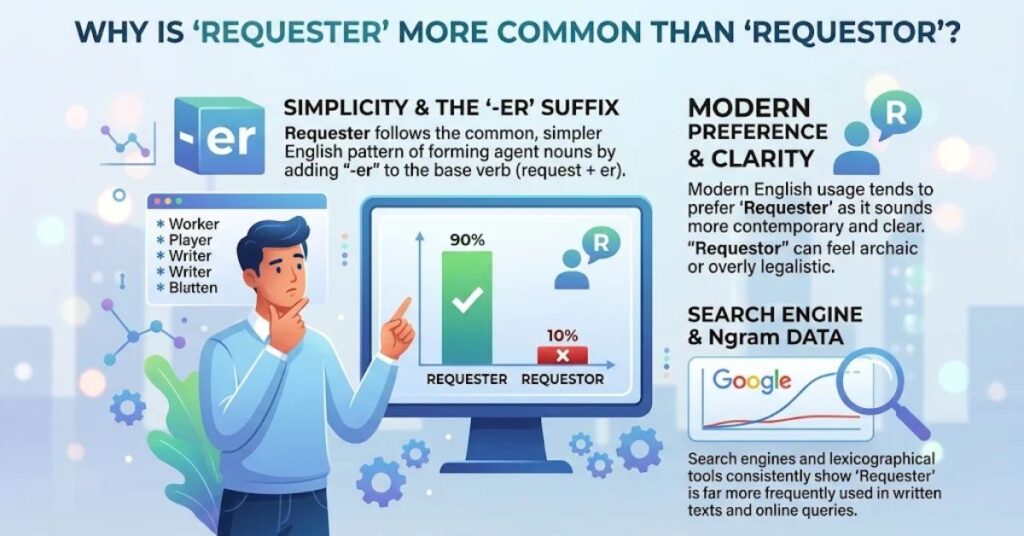
English uses different suffixes to create nouns describing people who perform particular actions. The endings -er and -or are both established, but their popularity varies from word to word.
Requester follows a highly familiar spelling pattern. Most English readers already recognize hundreds of words ending in -er.
Requestor, meanwhile, follows another accepted pattern that appears in words with established historical and linguistic backgrounds.
The difference isn’t governed by one simple rule. English spelling often reflects word history, pronunciation, and long-standing usage.
The -er Pattern
The suffix -er commonly identifies someone who performs an action. English speakers encounter this pattern in everyday vocabulary.
Consider these examples:
- Teacher: Someone who teaches.
- Writer: Someone who writes.
- Reader: Someone who reads.
- Builder: Someone who builds.
- Speaker: Someone who speaks.
- Requester: Someone who requests.
Because this pattern appears so frequently, requester feels familiar to most readers.
When someone asks which spelling to use in an ordinary email or report, requester usually provides the clearest and most recognizable choice.
Read More : Dieing or Dying: Understanding the Correct Spelling and Usage
The -or Pattern
The suffix -or also identifies people who perform particular actions or hold certain roles.
Examples include:
- Actor
- Creator
- Director
- Auditor
- Instructor
- Requestor
Many -or words have historical roots in Latin or developed through established English usage.
However, you shouldn’t assume that every verb can take either ending. English spelling depends on individual word conventions.
Requestor is accepted as an alternative to requester, but its lower frequency makes it less common outside specialized professional environments.
When Should You Use Requester?
Use requester when writing for general readers or communicating in situations where no specific industry terminology applies.
It works well in everyday English because most people recognize the spelling immediately.
You can confidently choose it for articles, reports, emails, educational materials, and many professional documents.
Here are some situations where requester is a suitable choice.
General Writing
Requester works naturally in blogs, articles, websites, manuals, and everyday written communication.
For example, if you’re explaining how to submit an online application, you can write:
The requester must provide accurate contact information.
The sentence sounds clear and familiar. There’s no need to use the less common alternative when writing for a general audience.
Business Communication
Requester is an excellent choice for professional emails, internal memos, client correspondence, and workplace documents.
For example:
Our team will contact the requester after reviewing the submitted information.
The spelling keeps business communication straightforward. It also helps maintain consistent terminology across reports and company documents.
Academic Writing
In academic writing, requester can describe someone who asks for information, research assistance, or access to particular resources.
You might see it in research reports, educational materials, and administrative documents.
For example, a university department could identify a student who requests access to specific research records as the requester.
Always follow your institution’s preferred style guide when preparing formal academic work.
Example
Here’s a simple example of requester in a professional context:
The requester submitted the required documents before the application deadline.
The word identifies the person who initiated the application process. It doesn’t suggest whether the application has been accepted or rejected.
When Should You Use Requestor?
Choose requestor when an organization, industry, or established document already uses that spelling.
Although requester is more common overall, changing established terminology isn’t always helpful. Consistency matters in professional environments.
Requestor frequently appears in specialized settings where software labels, internal policies, and formal documentation follow a particular convention.
Legal Documents
Some legal documents, contracts, agreements, and government forms use requestor to identify the person submitting a formal request.
For example, a legal form might require the requestor to provide identification before processing a document request.
If a legal department consistently uses this spelling, follow its terminology rather than introducing a different version.
Procurement Systems
Procurement departments often use requestor to describe employees who submit purchasing requests.
A requestor might ask the purchasing team to obtain office supplies, equipment, software, or other business resources.
For example, a procurement platform may display the requestor’s name, department, approval status, and purchase requisition number.
Using the established label helps employees understand the system.
IT Service Management (ITSM)
IT service management platforms help organizations handle technical problems, support tickets, and service requests.
Some systems use requestor to identify the person who submits a ticket.
For example, an employee might report a computer problem through the company’s help desk. The system records that employee as the requestor.
This field helps IT teams track requests, send system-generated notifications, and communicate updates about ticket status.
Example
Consider this sentence:
The requestor must approve the purchase requisition before the procurement team processes it.
This example fits a specialized business environment where requestor is already established terminology.
Requester vs Requestor Examples in Sentences
Sentence examples make spelling differences easier to understand. Both forms work in similar situations, so the surrounding context determines which one sounds more appropriate.
Requester Examples
Here are six examples using requester:
- The requester asked for a copy of the final report.
- Every requester must complete the registration form.
- The requester received an automated response.
- Our team contacted the requester directly.
- The requester updated the support ticket.
- The manager approved the requester’s application.
Each sentence uses the more common spelling for general and professional communication.
Requestor Examples
Now look at these sentences using requestor:
- The requestor submitted a procurement request.
- The requestor approved the contract revision.
- The requestor received system-generated notifications.
- The requestor provided supporting documentation.
- The requestor was informed about the approval status.
- The requestor signed the purchasing agreement.
These examples show how requestor fits naturally into formal and specialized environments.
Industry-Specific Usage Guide
Different industries sometimes develop their own spelling preferences. An organization might choose requestor because its software, forms, and internal policies already use that term.
Understanding these conventions helps you select the right word without creating unnecessary inconsistencies.
| Industry | Commonly Used Term |
|---|---|
| General English | Requester |
| Business Writing | Requester |
| Academic Writing | Requester |
| Journalism | Requester |
| Customer Service | Requester |
| Procurement | Requestor |
| IT Service Management | Requestor |
| Government Forms | Requestor |
| Legal Documentation | Both |
These are general usage tendencies rather than strict industry-wide rules. Individual organizations may prefer a different spelling.
When writing for a particular company or department, check its documentation first. Following established terminology makes your communication easier to understand.
Requester vs Applicant
Requester and applicant may seem similar because both words describe people seeking something. However, they don’t have exactly the same meaning.
A requester is someone who asks for information, assistance, approval, or an action. An applicant is someone who formally applies for a position, opportunity, service, or benefit.
For example, someone requesting a copy of a company report is a requester. Someone submitting a job application is an applicant.
A person can sometimes be both. Someone applying for a university scholarship might also request additional information from the admissions department.
Examples
Consider these examples:
- Requester: The requester asked the company for a copy of its policy.
- Applicant: The applicant submitted a job application.
- Both: The applicant requested additional details about the interview process.
The words describe different roles, so choose the one that accurately reflects the person’s action.
Can Requester and Requestor Be Used Interchangeably?
Yes. In most situations, requester and requestor can replace each other without changing the basic meaning.
Both identify someone who makes a request. For example, you can write The requester submitted the form or The requestor submitted the form.
The message remains the same.
However, interchangeable doesn’t mean you should switch between the spellings randomly. Readers may assume you’re describing two different people or roles.
This matters particularly in business reports, legal agreements, technical documentation, and procurement records.
Best Practice
Choose one spelling and use it consistently throughout your document.
For general writing, requester is usually the safest choice. However, if your company uses requestor in its software or official documents, follow that convention.
Avoid switching between both forms unless they intentionally identify different roles.
Consistency keeps your writing professional and prevents unnecessary misunderstandings.
Common Mistakes Writers Make
Even experienced writers sometimes confuse these spellings. Understanding a few common mistakes can help you avoid awkward wording and inconsistent documents.
1. Thinking Requestor Is Incorrect
Requestor isn’t a spelling mistake. It’s an accepted English word with the same basic meaning as requester.
The difference involves popularity and usage preference.
2. Assuming Different Meanings
Some writers believe requester and requestor describe different responsibilities. However, both refer to someone who makes a request.
Don’t create a meaning difference that doesn’t exist.
3. Mixing Both Spellings
Using requester in one paragraph and requestor in another can confuse readers.
Choose one form unless your document intentionally distinguishes separate roles.
4. Ignoring Industry Standards
Changing requestor to requester in an established procurement system or legal document might create inconsistency.
Always check the organization’s preferred terminology before editing official documents.
Pro Tips for Choosing the Correct Spelling
Choosing between these words doesn’t have to be difficult. A few simple guidelines can help you make the right decision.
Tip #1
Use requester for blogs, websites, articles, and other content written for general readers.
Tip #2
Choose requester for everyday professional communication unless your organization follows another spelling convention.
Tip #3
Use requestor when your company’s legal documents, forms, or software already follow that terminology.
Tip #4
Maintain consistent spelling throughout emails, reports, contracts, and technical documentation.
Tip #5
When writing for an American English audience, prefer requester unless a specific industry or organization requires requestor.
Frequently Asked Questions
Is requester or requestor correct?
Both are correct English words. However, requester is more common and generally preferred in modern American English.
What is the difference between requester and requestor?
Both describe someone who makes a request. Their main difference involves spelling preference and usage frequency.
Is requestor a valid English word?
Yes. Requestor is an accepted English noun used in legal, procurement, government, and IT-related environments.
Why is requester more common than requestor?
Requester follows the familiar English -er pattern, which appears in many everyday nouns describing people performing actions.
Can requester and requestor be used interchangeably?
Yes. Both usually have the same meaning, but you should maintain consistent spelling throughout your document.
Which spelling do dictionaries prefer?
General English references recognize both forms, but requester is more widely used in everyday modern English.
How do you use requester in a sentence?
Example: The requester submitted the required documents before the application deadline.
How do you use requestor in a sentence?
Example: The requestor approved the purchase requisition through the company’s procurement system.
Is requestor commonly used in business writing?
It appears in some business environments, particularly procurement and enterprise software, but requester remains more common overall.
Should I use requester or requestor in American English?
Use requester for general American English writing. Choose requestor when following an established organizational or industry convention.
Final Verdict
When comparing requestor or requester, remember that both spellings are correct and describe the same person: someone who makes a request. The main difference involves how frequently people use each word. Requester is the more familiar option in modern American English, business communication, academic writing, and everyday documents. Requestor remains an accepted alternative, particularly in legal documentation, procurement systems, government forms, and IT service management. Neither spelling changes the meaning of your sentence, so there’s no need to treat one as a grammatical error.
If you’re writing for a general audience, choose requester. It’s clear, natural, and widely recognized. However, always respect your organization’s established terminology when preparing specialized documents. A simple spelling choice can make your writing more consistent and professional. When in doubt, follow the audience, consider the context, and keep your spelling consistent from beginning to end.

Abu Bakar is a meaning-focused content writer specializing in names, word definitions, phrases, and symbolic interpretations. He focuses on researching origins, explaining concepts, and presenting clear, engaging information that helps readers understand the deeper meanings behind everyday words.
Connect with Me on: Facebook